
History of Al-Aqsa Mosque — From the Dawn of Creation to Today
If the walls of Al-Aqsa Mosque could speak, they would tell the complete story of humanity from the first prophets. This blessed site in the heart of Jerusalem was never merely a building — it was always the destination of heaven on earth. Understanding its history does not mean studying stones and domes, but tracing the footsteps of the prophets who walked this blessed ground.
The Prophetic Roots — The First House Established for Mankind
In the Islamic narration, the Grand Mosque in Mecca and Al-Aqsa Mosque in Jerusalem are the first two houses established for the worship of Allah on earth. Abu Dharr al-Ghifari (RA) reported asking the Prophet (peace be upon him): "Which mosque was placed first?" He said: "The Grand Mosque." I asked: Then which? He said: "Al-Aqsa Mosque." I asked: How long between them? He said: "Forty years."
This hadith places Al-Aqsa in the time of Ibrahim (Abraham) or before. Prophet Sulayman (Solomon) renewed its construction around the tenth century BCE. Dawud (David) before him prepared for this building and gathered its materials, but was told his son would build it. This makes Al-Aqsa not merely a historical site, but a prophetic covenant passed down from Ibrahim to Sulayman to Muhammad, peace be upon them all.
The Islamic Conquest — Umar Enters Jerusalem Without War
In 636 CE, Patriarch Sophronius signed Jerusalem's surrender with one condition: that the Caliph come in person. Umar ibn al-Khattab (RA) arrived on foot, alternating with his servant on his camel. He entered Jerusalem in travel-worn clothes, and when prayer time came at the Church of the Holy Sepulchre, he refused to pray inside — fearing Muslims would later turn it into a mosque.
Umar wrote the Covenant of Umar, granting the people of Jerusalem security for their lives, churches, and crosses. He then went to the site of Al-Aqsa, which had been left neglected and used as a rubbish dump under Byzantine rule, and cleaned it with his own hands. He ordered a simple wooden mosque built to hold three thousand worshippers. Under Uthman ibn Affan (RA) later, it was rebuilt and expanded with better materials.
The Umayyad Era — The Dome That Became the Symbol of Islam
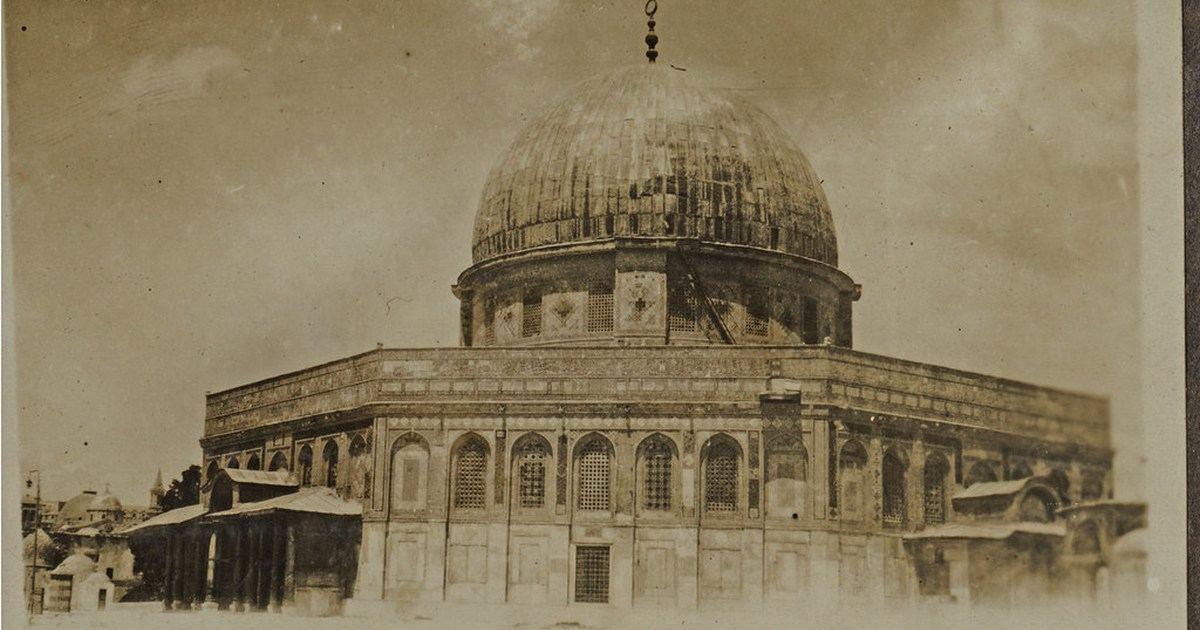
In 691 CE, Caliph Abd al-Malik ibn Marwan built the Dome of the Rock over the Rock from which the Prophet (peace be upon him) ascended to the heavens. Construction took seven years and cost seven full years of Egypt's tax revenue. It was designed in a unique Islamic-Byzantine style combining golden mosaics with Quranic verses from Surah Al-Isra and Maryam. The golden dome that shines over Jerusalem's skyline is the Dome of the Rock — not the main Al-Aqsa Mosque, which many people confuse.
Eighteen years later, in 709 CE, Al-Walid ibn Abd al-Malik completed the main Al-Aqsa Mosque — the rectangular building with the silver dome in the southern part of the compound. Wood was replaced with carved marble. For the first time in its history, the mosque took on its complete Islamic form.
The Mamluks and Ottomans — Centuries of Preservation
The Mamluks (1250-1517 CE) surrounded Al-Aqsa with a network of religious schools, fountains, and lodges — including the Tankiziyya and Ashrafiyya schools still standing today. They transformed the Noble Sanctuary into a complete educational city.
Ottoman Sultan Suleiman the Magnificent (1520-1566 CE) completely rebuilt Jerusalem's surrounding walls — those same walls visible in tours of Jerusalem today. He ordered the Dome of the Rock covered with the colored ceramic tiles that clothe it to this day. Sultan Abd al-Majid I restored parts of the mosque after an 1837 earthquake damaged it.
Each era added a layer — but the spirit remained the same: a place toward which Muslims turn their hearts from every corner of the earth.
Al-Aqsa Today — And Connecting with It from Afar
Al-Aqsa Mosque today is an Islamic religious complex spanning 144 dunams under the supervision of the Jordanian Islamic Waqf, receiving thousands of worshippers daily and standing as a symbol of Muslim resilience in Palestine.
For Muslims who cannot reach it, Al-Aqsa Blessings offers a personal du'a prepared with care, delivered within 48-72 hours — a modern way to connect with an ancient place.
Frequently Asked Questions About the History of Al-Aqsa Mosque
What is the difference between Al-Aqsa Mosque and the Dome of the Rock?
Al-Aqsa Mosque is the full Islamic religious complex on the Temple Mount. The Dome of the Rock is a building within it, constructed in 691 CE over the Rock from which the Prophet (peace be upon him) ascended. The main Al-Aqsa Mosque is the rectangular building with the silver dome in the southern part of the compound, built in 709 CE. Many confuse the two because of the prominent golden dome in pictures of Jerusalem.
How old is Al-Aqsa Mosque?
The prophetic hadith indicates the site has been a place of worship since the time of Ibrahim (Abraham) or before — over 4,000 years. The Islamic mosque we see today was built in the Umayyad era in 709 CE, with the Dome of the Rock built in 691 CE.
Why does Al-Aqsa Mosque remain the center of world attention?
Because it stands at the intersection of three Abrahamic faiths at a single point. Muslims consider it the third holiest site and the first qibla. Christians are deeply connected to Jerusalem through the life of Jesus (PBUH). Jews consider the Mount the site of their Temple. This intersection gives it a historical and religious weight unmatched anywhere on earth.
Al-Aqsa Mosque did not write its architectural history alone — it was written by the tears of worshippers, the prostrations of prophets, and the footsteps of caliphs who came on foot out of reverence for Allah.
How this helps the reader today
If you are searching for the history of Al-Aqsa, you probably want more than dates and eras. You want to understand why this place remains alive in Islamic memory, and why it is tied to faith, identity, Jerusalem, and prayer. That is why this page works best as a starting point, followed by Prophets in Palestine, The Night Journey, and The Importance of Al-Aqsa Mosque.
What the visitor should learn
- Al-Aqsa is not just one building, but a large religious and historical complex.
- Each era added a layer of preservation, restoration, or resilience.
- Understanding Al-Aqsa helps explain a major part of the Islamic narrative around Jerusalem.
Bottom line
The history of Al-Aqsa Mosque is a history of worship, patience, and renewal — and a reminder that the place Allah blessed remains alive in the hearts of believers, no matter how the centuries change.
Request Your Personal Du'a from Al-Aqsa Now
Get a personal du'a video delivered within 48-72 hours
Request Now